Showing posts with label gt classroom projects. Show all posts

Wednesday, September 21, 2011

STAR GAZER RESULTS

We finished our 12 constellations and had some extra circles left to make a few new galaxies and star clusters. Thanks to fifth grader KW for the idea! :-)
Spiral Galaxy or Star Cluster? I aimed the camera down the Pringles can to see what would show up. Cool!

Another one! Terrific work!

Hmmm?
That's a new one I've not seen in the star charts yet. It's an interesting star cluster. Do you think it contains a planet with intelligent life? I'm sure it must!


Thanks for visiting. :-)

Sunday, September 4, 2011

WEEK 2~ THE SUN AND THE STARS (PART 1)

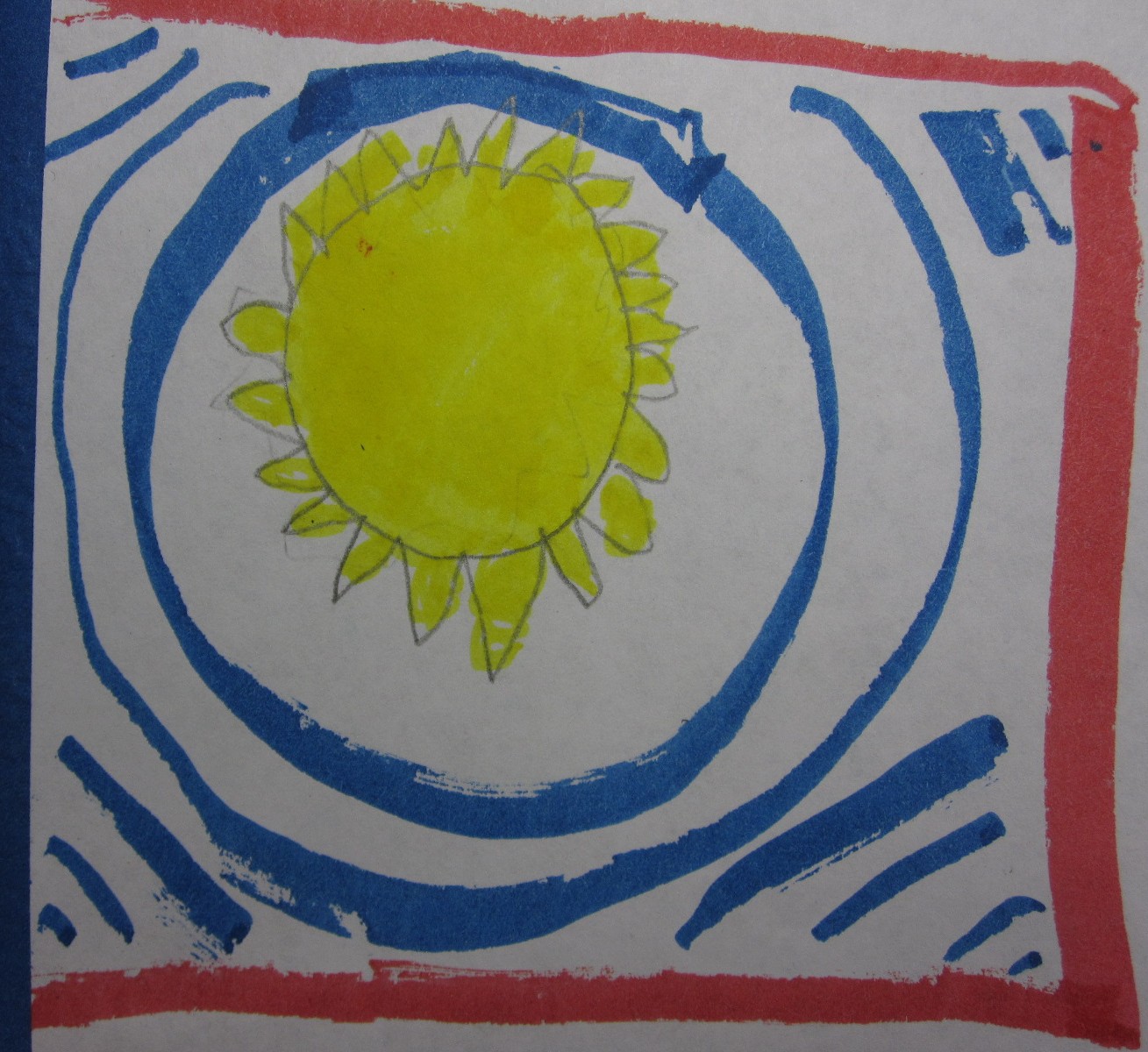
                                                         (drawing by NM 3rd grade)

NEVER LOOK DIRECTLY AT THE SUN, EVEN WITH SUNGLASSES! A VERY FAMOUS ASTRONOMER WENT BLIND BY STUDYING THE SUN AND TRYING TO VIEW IT THROUGH MIRRORS! DON'T DO IT!
Questions to answer:

1. Is the sun simply a giant ball of hot gases?  Or does it have layers and other features?

2. Does NASA have an orbiting spacecraft around the sun?

3. Why should we study the sun? What do sunspots, solar flares, and solar prominences look like?

4. Is our sun large or small compared to other stars?

5. What are galaxies? How many stars make up a galaxy?

Lesson 1: Images
Our Sun


Parts of the Sun
(For your interactive notebook)


An illustration of the structure of the Sun:
1. Core
2. Radiative zone
3. Convective zone
4. Photosphere
5. Chromosphere
6. Corona
7. Sunspot
8. Granules
9. Prominence


Photographers and Astronomers can capture some of the intracacies of the sun during a total eclipse or with a special filter and lenses (image by Luc Viatour)
Do you know what the white halo is called?


Our study of the sun continues. We need exact measurements of the sun's light in order to find planets around distant stars. This machine is called a light laser. What does it use to split light?

PART 2: OTHER STARS

Stars emit different colors. We can see yellow, blue, red, orange, and of course white stars.
On a clear night you would need to 'watch' a star for some time before it has a color. Rigel is one of the blue stars we can see. Some stars have names. Others have numbers.

Stars continue to form. This dramatic scene was taken by the telescopes at the European Southern Observatory. Try and count the stars in the photo!

Part 3: Constellations and Star Fields

From early times, many cultures have put the stars together and made patterns. Many of these are still famous and we continue the tradition of using these names. These star patterns are called constellations. The International Astronomical Union recognizes 88 constellations. This beautiful star chart dates from earlier times. What can you see?
SOHO

SOHO has been sending back early warning signals to Earth since the 1990s. This spacecraft is in a very unusual part of space. It is 1 AU from the Earth and 92 AU from the sun. This is the location of an invisible part of space where Earth's gravity and the Sun's gravity are equal. 

Projects....Making a Straw Rocket
Cut out and decorate all 3 parts from the NASA handout. Put your initials on one portion.

Roll the body of the rocket lengthwise around a pencil and tape in place.

Tape the fins and bend the fins in a plus sign formation.

Twist or pinch the top of the rocket and tape shut to form a 'nose'. The rocket body and nose must be airtight for good flights. Three pieces of tape along the body should be enough.

Bend the straw at the elbow for a proper angle. Do not point the rocket at other people.

A good rocket should fly at least 2 meters (about 6 feet).
Try it at different angles and record your results, both good and bad.
Use the tape marks on the carpet to determine the length of your flights.

PERSONAL LEARNING DEVICE:

We had two apps on view today. One took us on a tour of the Milky Way with animated orbits of the planets. The other located constellations in the night sky by pointing it at a direction overhead. Thanks to HP and MM for sharing. :-)
Mr. Petersen/ :-)

Thursday, August 25, 2011

WEEK 1 ~ INTRODUCTION TO SPACE EXPLORATION/ EARLY HISTORY OF AVIATION/ MERCURY/ WHEN WORLDS COLLIDE


LET'S TALK ABOUT OUR PURPOSE FOR THIS UNIT.
QUESTIONS TO ANSWER:


1. WHY SHOULD WE CARE TO LEARN ABOUT THE SOLAR SYSTEM?


2.  DO WE NEED TO EXPLORE SPACE?


3. WERE OUR ANCESTORS CURIOUS ABOUT THE NIGHT SKY AND STARS?


4. HOW DID ROCKETS BEGIN? WAS THERE A TIME WHEN WE WERE NERVOUS ABOUT GOING OUT INTO SPACE? WERE THERE DANGERS INVOLVED IN EARLY SPACE EXPLORATION?

5. IS IT TRUE WE SENT DOGS AND CHIMPANZEES INTO SPACE?


6. SHOULD WE CONTINUE TO SEND UNMANNED MISSIONS INTO SPACE?


7. SHOULD WE PLAN FUTURE MISSIONS TO THE MOON? TO MARS? TO OTHER PLACES?


8. WHY IS THERE SUCH A DIFFERENCE BETWEEN SPACECRAFT IN MOVIES AND GAMES AND ACTUAL NASA SPACE PROBES AND ROCKETS?


IN YOUR INTERACTIVE NOTEBOOK, PICK ONE QUESTION TO ANSWER. ILLUSTRATE YOUR ANSWER IF YOU CAN.

                                                                      LESSON 1:
ILLUSTRATIONS FOR HISTORY OF
SPACE FLIGHT : EARLY DREAMS OF FLIGHT
Hot air balloons were the first step in controlled ventures into our atmosphere.

The Montgolfier Brothers of France flew the first manned balloons in 1783.
These were elaborate flying machines weighing over 500 pounds and carrying people thousands of feet into the air. One of the earliest flights took three animals up into the atmosphere to see if it was toxic to life*. Can you guess which 3 animals made the flight?

*As late as the 1700s, there was a common belief that only the air near the surface was safe and that the higher layers of air were filled with poisons. Of course, this is not true. But to the first hot air balloonists, this was a worrisome and dreadful thought. To the audiences amazement, the 3 animals were not poisoned that day by the atmosphere and safely returned to the ground.

As balloons developed into airships, one of the most difficult problems to solve was getting them to turn full circle. This airship won an important award and a large sum of money for being the first to fly past the Eiffel Tower and return to the starting point.


Do you think this flight was successful? Why?

Otto Lillienthal ~ Germany ~ first controlled gliding experiments. This is called a fixed wing flight and caused quite a sensation. The Wright Brothers would also experiment with fixed wings a number of years later.


The Wright Brothers of Ohio

Early gliding experiments at Kitty Hawk. Notice there's no motor.


Wright Brothers ~ North Carolina ~ December 1903
First heavier than air motorized flight.


Later flights by the Wright Brothers lasted up to an hour. ~ Ft. Myers, Florida

LESSON 2:    IMAGES FOR PLANET MERCURY LESSON
Mariner 10 (The first 9 Mariner missions failed in their attempt to orbit the planet)


 The Messenger mission recently sent back this image of the planet's surface.


Orbit of Mercury
Question: How many revolutions does Mercury make for every 1 revolution of Earth?

LESSON 3:
WHEN WORLDS COLLIDE: THE STORY OF METEORS & IMPACT CRATERS

Odessa, Texas

The impact crater rim rises to 15 feet above the surrounding plain.

Near Winslow, Arizona ~ Meteor Crater Museum

Meteor Crater is a 50,000 year old impact crater in the desert of Arizona. You can see the visitor center on the rim.

PROJECT 1:  IMPACT CRATER MODEL

Materials:  Foam 'to go' box, clay, black sharpie, notecard
Click to enlarge the photo to see the information card.
Best idea: Smooth out the clay in the bottom of the container, then 'pinch' circles to make the craters stand out above the surface. Put black dots around the rims to help see the craters.

PROJECT 2: INVENT & ILLUSTRATE THE FIRST MODE OF FLIGHT
TIMEFRAME: 1100s TO THE 1800s


You may 'dream' of harnessing the power of birds, balloons,  and sails, or think of your own idea. Remember, the earliest ideas used the power of wind and hot air, not motors.


image sources: Wikipedia & NASA